
Dr. Roberto Torrent attended the 7th fib Congress 2026 in Lisbon, where he presented a technical contribution focused on the relationship between concrete diffusion and air-permeability coefficients, a topic directly connected to the use and relevance of the PermeaTORR method.
A technical contribution connected to PermeaTORR
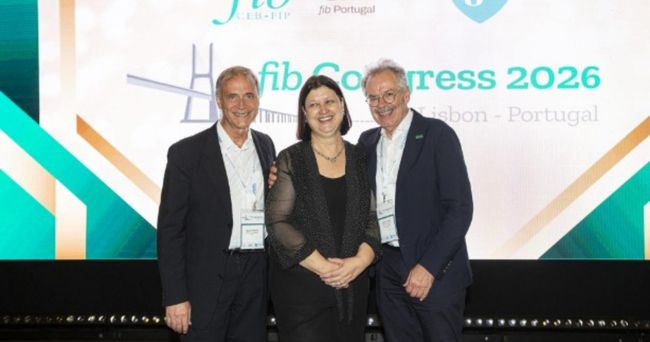
Dr. Roberto Torrent participated in the 7th fib Congress 2026, held in Lisbon from June 15 to 18, 2026, under the theme “Structural Concrete 2050 – Towards Carbon Neutrality, AI Design and Robotic Construction.”
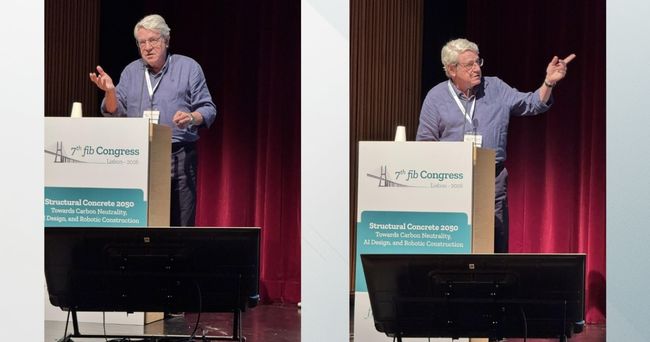
During the congress, he presented the contribution “Diffusion and Permeability Coefficients of Concrete: Theoretical and Experimental Relations”, authored by R. Torrent, F. Moro and V. Bueno León.
The presentation addressed a key technical issue for concrete durability: the relationship between air permeability and diffusion processes associated with carbonation- and chloride-induced steel corrosion.
From laboratory diffusion tests to in situ air-permeability assessment
The contribution highlights that the experimental determination of gas and chloride diffusion coefficients is complex, time-consuming and usually limited to laboratory conditions.
By contrast, the determination of the air-permeability coefficient kT is faster, easier and suitable for non-destructive in situ measurements. This makes it possible to assess the as-built quality of concrete structures directly in the field.
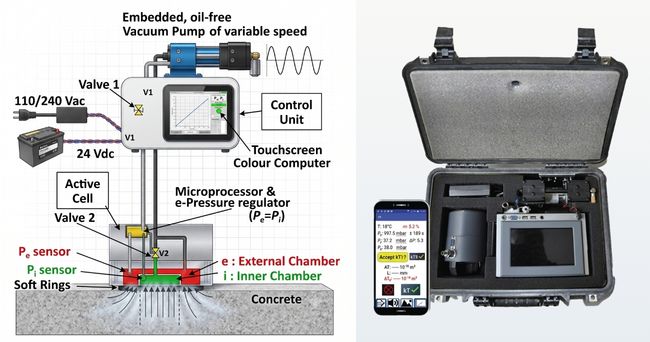
This technical approach is directly connected to PermeaTORR, a system designed to measure the air-permeability coefficient kT of hardened cover concrete through the double-chamber vacuum cell method.
Supporting more realistic service life predictions
The work explored correlations between the air-permeability coefficient kT and diffusion coefficients for gases and chlorides. These correlations may help estimate diffusion behavior through fast, non-destructive site measurements.
This opens the way to more realistic service life predictions for concrete structures, especially in demanding infrastructure projects exposed to carbonation or chloride-induced corrosion.
The contribution also refers to the application of this approach in the Hong Kong-Zhuhai-Macao Sealink in China.
International technical exchange
The 7th fib Congress gathered researchers, engineers and industry professionals from the international concrete community.
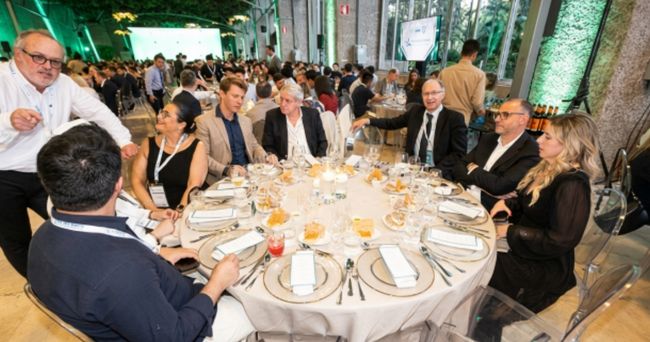
The event provided a valuable space to discuss the future of structural concrete, durability assessment, carbon neutrality, AI-assisted design and robotic construction.
For PermeaTORR, this technical presence reinforces the relevance of air-permeability testing as a practical tool for concrete durability evaluation, field quality control and long-term service life assessment.